
Sunday, December 16, 2018

Wednesday, August 15, 2018
This blog: A new hope?
It's been over 2 years since I've posted anything in the bloggy; Facebook pretty much killed blogging a long time ago. Still, whenever I need to find some highlight or signpost from the old days, I always check this bloggy first, and it never disappoints.
Perhaps I'll start entering posts here again, mostly in an effort to motivate me to get out there and bird more. Life has taken quite a busy turn of late; I'm now married with a son, and that little man takes up a lot of time. He's only 7-1/2 months old, so he needs us an awful lot. Between work, him, my blacksmithing (yeah I do that too now), rockhounding (yup, that too), and my woodworking and spoon carving (don't do that nearly enough anymore either!), birding has taken a hit. About the only time I'm sure to be out there is when I go on a trip because #everytripisabirdingtrip!
Does Blogger even recognize what a hashtag is? Clash of technologies!
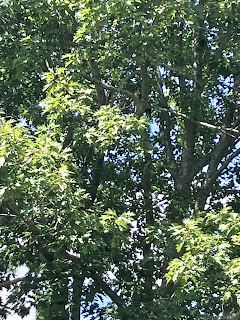
Today, I stand at 457 lifers. My last bird was the famous Great Black Hawk that hung out in Biddeford, Maine, for a few days early this month. I happened to see him on his last day: I cut out of work for a "long lunch" and drove the 35 minutes to the intersection of Fortunes Rocks Road and Lily Pond Avenue, right on the coast. A lot of posh homes and rocky beaches, highlighted by the presence of a very flighty GBHA! I saw him within 5 minutes of my arrival, which was quite exhilarating. I followed him for a bit, and I even managed to get a horrible photo of him on my iPhone. Why didn't I bring my camera!?

Perhaps I'll start entering posts here again, mostly in an effort to motivate me to get out there and bird more. Life has taken quite a busy turn of late; I'm now married with a son, and that little man takes up a lot of time. He's only 7-1/2 months old, so he needs us an awful lot. Between work, him, my blacksmithing (yeah I do that too now), rockhounding (yup, that too), and my woodworking and spoon carving (don't do that nearly enough anymore either!), birding has taken a hit. About the only time I'm sure to be out there is when I go on a trip because #everytripisabirdingtrip!
Does Blogger even recognize what a hashtag is? Clash of technologies!
Today, I stand at 457 lifers. My last bird was the famous Great Black Hawk that hung out in Biddeford, Maine, for a few days early this month. I happened to see him on his last day: I cut out of work for a "long lunch" and drove the 35 minutes to the intersection of Fortunes Rocks Road and Lily Pond Avenue, right on the coast. A lot of posh homes and rocky beaches, highlighted by the presence of a very flighty GBHA! I saw him within 5 minutes of my arrival, which was quite exhilarating. I followed him for a bit, and I even managed to get a horrible photo of him on my iPhone. Why didn't I bring my camera!?

See him? No??? Well, let me help you.

Zoomed and circled here, the hawk is facing left.
It was such a thrill to see this visitor from Mexico and points south; I'll likely never seen one again, which makes me a little sad, but I'm SO GLAD I took that long lunch! Later that afternoon, only hours after I'd seen him, he flew out to sea and was gone.
That's one crazy bird. This article explains that the consensus is that this is the same bird as was seen on South Padre Island, TX, in April of this year. The crazier thing is, as someone quoted in the article points out, GBHAs don't migrate. So why this bird chose to fly to Texas and then to Maine is really anyone's guess, so Darwin might say he has a death wish; he's not likely to survive very long unless he heads back home, wherever that might be. Perhaps he's following in my footsteps.
Meanwhile, I've been doing some Excel-and-eBird obsessing/planning for future work-related trips (Orlando, FL, in Feb 2019; National Harbor, MD, in July 2019; and Nashville, TN, in Feb 2020), and I realized that I hit 400 lifers in 2013.
That was 5 years ago!
It's taken me 5 years to get 57 birds! And that includes the infamous puking pelagic trip, as well as two trips to SE Arizona (one in September 2013 and one in February 2017, not exactly high migration), a trip to Big Bend and western Texas (and my first Painted Bunting, among other things), and a San Antonio/home trip involving a Golden-cheeked Warbler!
That's a lot of miles for 57 birds.
At any rate, the planning for future lifers continues. That Orlando work trip may well yield 19 lifers, and that's just going to involve driving from Orlando and staying somewhere on the Space Coast! If I were to really branch out and go down to Ding Darling or even the Everglades, that number would go up 28 possible lifers. Of course, never count your lifers until they're spotted.
So there are birds out there. Hell, I still haven't even seen a Spruce Grouse up here in Maine, and my friend and potter Garrett Bonnema tells me he practically trips over them on his mountains hikes out in western Maine near Bethel (where my in-laws live). And there are American Three-toed Woodpeckers and Black-backed Woodpeckers (up in Baxter State Park, about 5 or 6 hours away) to see here as well. At least I got my Bicknell's Thrush on Mt. Washington last June.
There's still plenty to write about, too.
Friday, May 06, 2016
Springtime at Popham
Popham Beach is lovely this time of year, if a little cold. Last Saturday, AB and I took a long hike over Morse Mountain and onto Sea Wall Beach, which is connected to Popham. It was about a 5-mile hike, all told, and my little muscles were tight after that.
Sea Wall and Popham are great places to see an endangered bird, the Piping Plover, in all its cuteness--and to hope to catch a glimpse of their ridiculously precious babies. I didn't see any babies yet (it's probably a little early), but I did see some adults and some other birds, in their fresh breeding outfits, looking to get lucky.


Sea Wall and Popham are great places to see an endangered bird, the Piping Plover, in all its cuteness--and to hope to catch a glimpse of their ridiculously precious babies. I didn't see any babies yet (it's probably a little early), but I did see some adults and some other birds, in their fresh breeding outfits, looking to get lucky.

A Yellow-rumped Warbler, looking very dashing.

A whole lot of Glossy Ibises looking glossy.

The aforementioned Piping Plover, looking cute.

The same little plover, scratching an itch. Squeeeeeeeeeeeeeeeee!
I do so love living so close to the beach. Popham is about 40 minutes away, but the actual coastline is only about 5 minutes down the road. But Popham--or in this case, Sea Wall Beach, is lovely. At low tide, it's an enormous stretch of sand--which is a bit of a rarity up here on the rocky coast of Maine.

Looking to my left, toward Popham.

Looking to my right, back toward Brunswick.
This afternoon, I sat out on my deck and watch Pine Warblers, Downy and Hairy Woodpeckers, and Black-capped Chickadees eat suet and seeds from my feeding station. It was a thrill to see the Piney stand on the very metal hook that I forged myself a couple of weeks ago! I wish I'd gotten a photo but I wasn't fast enough and I was too awestruck to care.
You can keep your 95-degree spring days, Texas. I'll take my 57-degree days up here anytime (as long as the sun is shining--otherwise, it's nippy!).
Subscribe to:
Posts (Atom)